Behaviour Approach
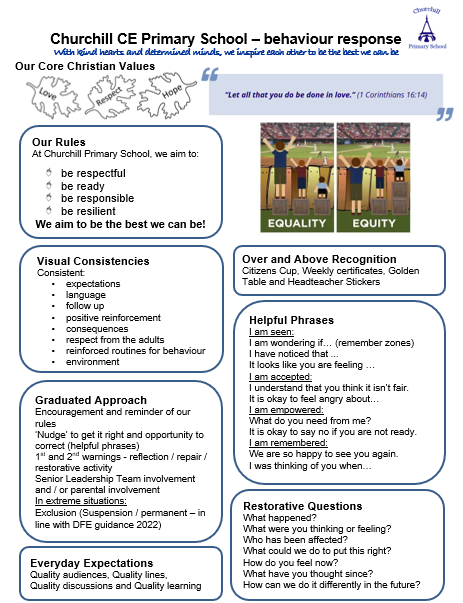
All we do as a community at Churchill Primary School is supported by our vision, values and ethos. Our Christian vision is to create a nurturing community in which we ignite curious minds, encourage generous hearts and embrace a changing world so our children can live life in all its fullness and we believe positive relationships are at the heart of this being achieved. This vision, alongside our three core Christian values and biblical underpinning, shapes all we do:
“Let all that you do be done in love.” (1 Corinthians 16:14) 
Our vision feeds into our school motto, which is known and lived by our pupils.
“With kind hearts and determined minds, we inspire each other to be the best we can be.”
Our Guiding Principles
At Churchill CE Primary School we aim to be ‘the best we can be’ and we believe positive relationships are at the heart of this being achieved. This policy supports the Department for Education’s ‘Behaviour in schools’ publication 2022 by “ensuring that high standards and expectations of good behaviour pervade all aspects of school life including the culture, ethos and values” and that “pupils learn in a calm, orderly, safe and supportive environment and protect them from disruption”.
We are committed to creating an environment where exemplary behaviour is at the heart of productive learning. Everyone is expected to maintain the highest standards of personal conduct, to accept responsibility for their behaviour and encourage others to do the same. Our approaches are underpinned by our four rules for life (illustrated on acorns), focussing on respectful behaviour and a positive learning atmosphere.
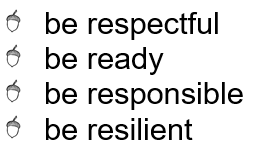

Our Behaviour for Learning Policy reflects the commitment to love, justice and forgiveness, using restorative and relational approaches grounded in Christian teaching. Behaviour systems emphasise respect, reconciliation and responsibility, and are reinforced regularly through services linking the four-character threads (Respect, Responsibility, Ready and Resilience) with biblical concepts.
We support each other to be ready to learn from mistakes - We are ready because the Bible teaches us to be prepared (1 Peter 3:15) and to listen with an open heart and mind (Proverbs 4:1).
We develop the resilience to do things differently - Resilience and perseverance are only possible where there is hope. The Christian value of hope is a recurring theme within the Bible. In the centre of our school we have a special stained glass window depicting a rainbow surrounding a white cross. This is a reminder of God’s promise to Noah (Genesis 9:8-17),
We take responsibility for our own actions - emphasises pupils taking responsibility for their actions and learning, with restorative conversations and “connect before correct.” We take responsibility because God calls us to act justly (Micah 6:8) and to carry our own load (Galatians 6:5), learning from mistakes and putting things right.
We show respect for those around us – "Treat others as you would want them to treat you." — Matthew 7:12
We recognise that understanding our emotions is a key aspect of understanding and managing behaviour. As a nurturing school, our approach (based on the Nurture UK 6 principles) ensures that the development of positive social, emotional and learning behaviours is at the heart of our behaviour policy. We understand that behaviour is a form of communication and is one of the six principles of Nurture. We are committed to the emotional and mental well-being of our staff, pupils and parents/ carers. We use our understanding of social and emotional development and learning as part of our approaches to all learning and in our response to behaviour.
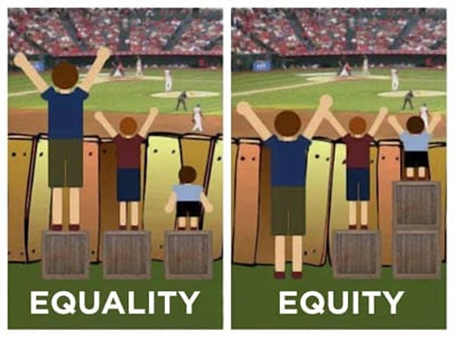
Our underpinning philosophy is that being ‘fair’ is not about everyone getting the same (equality) but about everyone getting what they need (equity) to succeed.
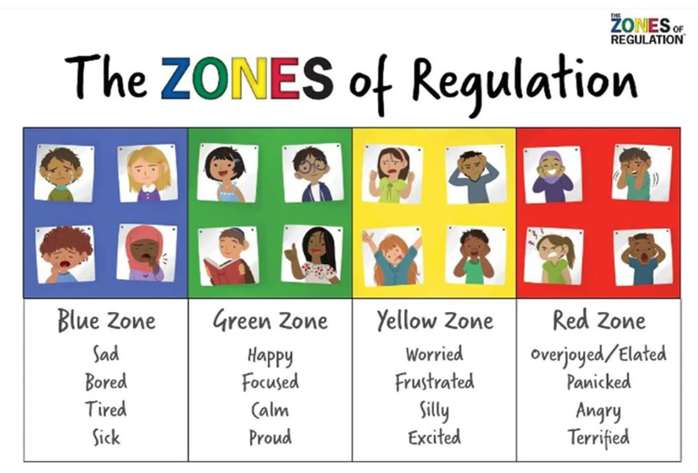
As a school, we use the Zones of Regulation to help both children and adults to be able to name feelings. These are taught regularly and are part of our school's daily routines. We have learnt about them in whole school worship as well as part of our Personal, Social and Health Education (PHSE) curriculum. We have shared with our pupils that the green zone is the most conducive for learning. However, we have shared that it is ok to have feelings in all the zones. The Zones of regulation charts are in every classroom and we encourage our pupils and staff to regularly throughout the day put their name against the colour they are feeling.
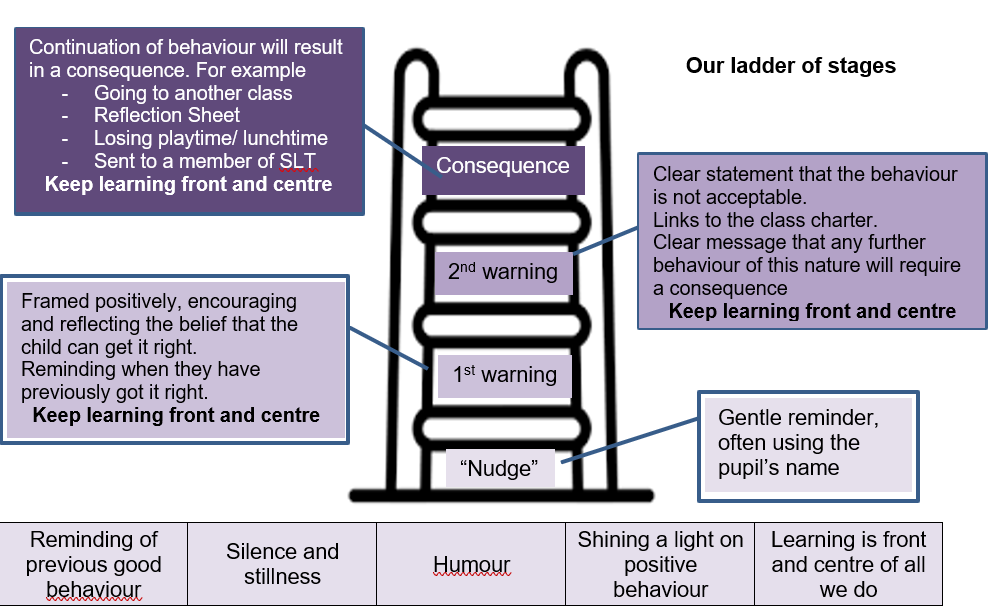
Our behaviour ladder.